Solar PV Monitoring Systems — IoT Dashboards for Solar Plant Operators and Installers
A solar PV plant without monitoring is essentially operating blind. You know how much energy it produces at the meter, but you don’t know which panels are underperforming, which inverters are running hot, or whether a fault occurred overnight. For small rooftop installations that might be acceptable, but for commercial solar farms, industrial installations, or multi-site deployments, the gap between what’s happening and what you can see becomes a real operational problem.
This page covers how WeMakeIoT approaches solar PV monitoring — what we have built, which platforms we use, and how the two main options (ThingsBoard and SensorVision) differ depending on what a project needs.
What a Solar PV Monitoring Dashboard Actually Does
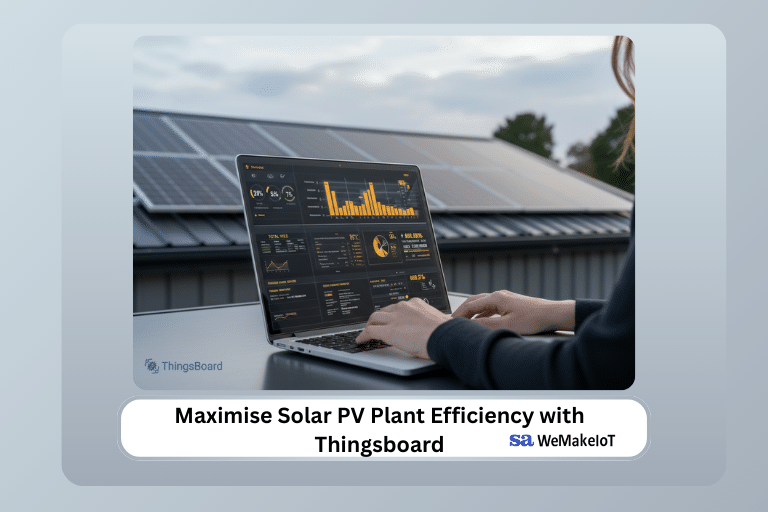
The core function is straightforward: collect data from inverters, charge controllers, and sensors across a solar installation and make that data visible and actionable in real time. In practice that means:
- Real-time yield tracking: Live energy production data per panel, string, or inverter — so underperforming units are visible immediately rather than showing up as a drop in monthly output figures.
- Fault detection and alerts: Threshold-based alerts that fire when a sensor reading goes out of range — inverter temperature, string voltage, production drop — so the right person gets notified before the issue compounds.
- Historical analysis: Trend data over days, weeks, and months — useful for maintenance planning, performance benchmarking, and identifying seasonal patterns.
- Remote device management: For distributed solar deployments, the ability to monitor device connectivity and push configuration or firmware updates without site visits.
- Multi-site visibility: A single dashboard view across multiple installations — relevant for solar farm operators, installers managing client sites, or energy companies with distributed assets.
A Project We Have Worked On
WeMakeIoT has delivered a solar field monitoring platform for a client who needed visibility across a distributed solar deployment. The system collected performance data from solar charge controllers, centralised it into a management dashboard, and provided analytics and device management across the fleet.
The platform handled:
- Data ingestion from solar charge controllers across distributed sites
- Centralised dashboard for real-time performance monitoring
- User and device management across the fleet
- Analytics for production trends and anomaly detection
- OTA updates for remotely deployed IoT devices
You can find this project on our Success Stories page under Solar Device Management Platform.
ThingsBoard vs SensorVision for Solar Monitoring
When a solar monitoring project comes to us, one of the first decisions is which platform to build on. We work with both ThingsBoard and our own platform SensorVision, and the right choice depends on the project requirements.
ThingsBoard is an open-source IoT platform well suited to projects with complex, custom requirements — specific dashboard layouts, unusual data processing rules, or integrations with third-party systems. It is highly flexible but requires more configuration time to get right. WeMakeIoT has delivered multiple ThingsBoard integrations for solar monitoring clients who needed this level of customisation.
SensorVision is WeMakeIoT’s own IoT platform — production-ready, white-label capable, and faster to deploy. It supports solar and energy monitoring out of the box, with real-time dashboards, threshold-based alerts, device management, and multi-tenant architecture. For clients who want a working monitoring system without a long build phase, or who want to offer solar monitoring as a branded service to their own customers, SensorVision is often the more practical choice.
Both options support MQTT and HTTP device connectivity, work with standard solar hardware, and can be configured for single-site or multi-site deployments.
Who Typically Works With Us on Solar Monitoring
- Solar farm operators who need visibility across a large installation and want alerts rather than having to log into a system to check status.
- Solar installers who manage multiple client sites and want a single platform to monitor all of them — and potentially offer monitoring as an ongoing service.
- Energy companies with distributed solar assets needing centralised performance data and device management.
- Solar hardware manufacturers looking to add monitoring software to their product offering — either as a branded platform or a white-label service.
Related Resources
- ThingsBoard Integration — custom setup and configuration
- SensorVision — white-label IoT platform for energy monitoring
- Success Stories — Solar Device Management Platform
- LoRa & LoRaWAN — long-range connectivity for remote solar sites
Working on a solar monitoring project?
Whether you need a custom ThingsBoard build or a faster deployment on SensorVision, we are happy to discuss what you are trying to achieve and which approach makes more sense for your situation.
Get in Touch →