
LoRa Point-to-Point, Star, or Mesh: How to Pick the Right Topology for Your IoT Network
“LoRa” and “LoRaWAN” get used almost interchangeably, but they’re not the same thing – and that mix-up is where a lot of topology decisions go wrong. LoRaWAN is one specific way of arranging LoRa devices (a star network through a gateway). It’s not the only option. A team could just as easily need a direct point-to-point link between two devices, or a mesh setup to get data out of a facility a single gateway can’t reach – and never realise those were on the table.
Topology is simply how your LoRa nodes talk to each other and to the network. Picking the wrong one means either overbuilding – gateway infrastructure for a job two devices could’ve done directly – or underbuilding – a network that can’t cover the physical layout it’s meant to serve. Here’s how the three common topologies actually differ, and where each one earns its place.
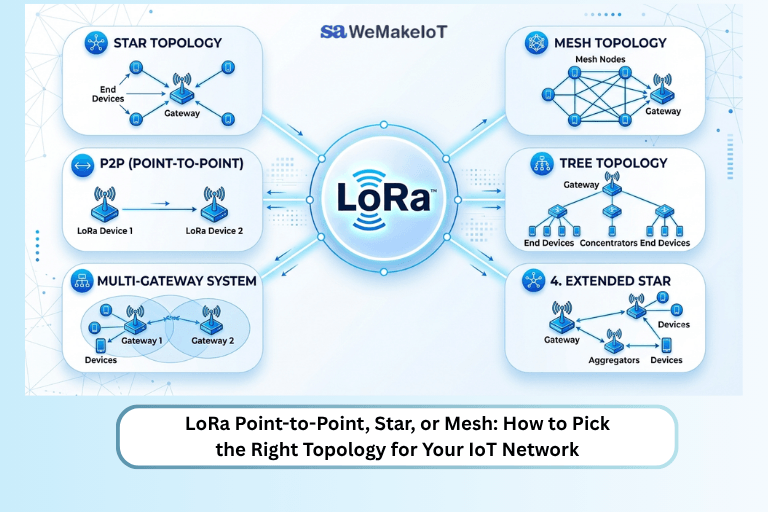
Point-to-Point: one sender, one receiver
This is LoRa in its rawest form – two radios talking directly, no gateway, no network server. You configure both ends on the same frequency and spreading factor, and they exchange packets directly.
Use it when: you have a small, fixed number of nodes (often just two) that need to talk directly – a sensor reporting to a single receiver at a control room, a proof-of-concept before committing to full LoRaWAN infrastructure, or a link where you don’t want data leaving your own hardware.
Why: it’s the cheapest and simplest option by far. No gateway cost, no network server, no third-party cloud dependency. The trade-off is that it doesn’t scale – add a tenth node and you’re managing addressing and collisions yourself.
Star: the LoRaWAN default
In a star topology, every end node talks directly to a gateway (or several), which forwards data to a central network server. This is what “LoRaWAN” means by default – a star-of-stars, since multiple gateways can each serve the same set of nodes for redundancy.
Use it when: you have sensors spread across a wide outdoor area – agriculture, utilities, asset tracking – where each node has a reasonably clear path to at least one gateway, and you want centralized device management, encryption, and the ability to add nodes without touching existing ones.
Why: it’s the most mature, best-supported option, with tooling (Chirpstack, The Things Network, ThingsBoard) built around it. The trade-off is coverage: if a node sits behind thick walls, underground, or too far from any gateway, star topology simply won’t reach it without adding more gateways.
Mesh: coverage through hopping
In a mesh, nodes don’t rely solely on a gateway – they can relay each other’s packets, hop by hop, until the data reaches its destination. This isn’t part of the core LoRaWAN specification; it’s typically achieved with proprietary firmware or add-on protocols layered on LoRa radios.
Use it when: you need to cover obstructed or irregular terrain – dense indoor facilities, forests, mines – where a handful of nodes can’t reach a gateway directly but can reach a neighbouring node.
Why: it extends coverage without adding gateway hardware everywhere. The trade-off is added latency (data hops multiple times before arriving), more complex power budgeting for relay nodes, and less standardisation than star topology – so tooling and long-term support vary more by vendor.
Quick way to decide
- Two devices, direct link, no infrastructure wanted → Point-to-point
- Many sensors, open or semi-open area, want standard tooling and easy scaling → Star (LoRaWAN)
- Sensors blocked from gateway line-of-sight, need hop-based coverage → Mesh
Most real deployments end up as a hybrid: a star network as the backbone, with a few mesh-relayed nodes filling coverage gaps a single gateway can’t reach.
Related reading
If you’re deciding between these, our LoRa point-to-point walkthrough covers the ESP32 + LoRa E5 setup we used for a direct link, and our LoRaWAN deployment experience goes into how we’ve built star-topology networks with Chirpstack and gateway hardware.
For a broader look at LoRaWAN services, gateway options, and where LoRa fits against ESP32, BLE, and cellular, see our LoRa & LoRaWAN page.
Weighing up topologies for a specific site or use case? Get in touch and we’re happy to think through it with you.