
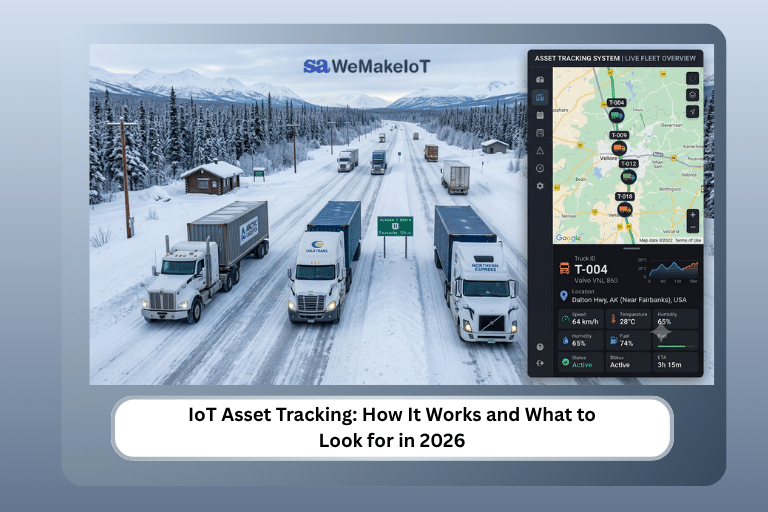
IoT Asset Tracking: How It Works and What to Look for in 2026
Most businesses find out an asset is missing, idle, or damaged only after the fact – a container that sat unmoved for three days, a piece of equipment that went missing between sites, a delivery that arrived outside temperature range with no record of when it slipped. IoT asset tracking exists to close that gap: instead of finding out after the fact, you know in real time.
This post covers what an IoT asset tracking system actually is, the main tracking technologies and how to pick between them, and a few real use cases where it makes a measurable difference.
What Is an IoT Asset Tracking System?
At its core, an IoT asset tracking system is three things working together:
- A tracker or sensor attached to the asset (a vehicle, container, pallet, or piece of equipment)
- A connectivity layer that sends the tracker’s data somewhere useful (GPS/cellular, LoRaWAN, or BLE)
- A dashboard or platform where that location and condition data is visualized, stored, and turned into alerts
The technology choice in the middle – GPS, LoRaWAN, or BLE – is usually where people get stuck, because each one solves a different problem.
GPS, LoRaWAN, or BLE: How to Choose
GPS + cellular is the right fit when assets move across wide areas with no fixed infrastructure – a delivery van, a container en route between ports, construction equipment moving between job sites. It gives continuous, accurate location anywhere there’s cellular coverage, but it draws more power and usually comes with a recurring SIM/data cost.
LoRaWAN fits assets that stay within a defined area – a warehouse, a campus, a farm, a mine site – where you can set up your own gateways. It trades some location precision for very low power draw and no recurring cellular bill, which is why LoRaWAN trackers often run for years on a single battery.
BLE (Bluetooth Low Energy) is best for short-range, high-density indoor tracking – knowing which shelf a tool is on, which room a hospital cart is in, or which dock a pallet is sitting at. It’s the cheapest and lowest-power option of the three, but only works within the range of BLE beacons or gateways you’ve already installed.
Indoor vs. Outdoor Tracking: Why It Matters
This is the single biggest factor people underestimate when scoping a project. GPS doesn’t work reliably indoors – signals don’t penetrate most roofing and walls well enough for a usable fix. So an asset that moves between a warehouse (indoor) and delivery routes (outdoor) usually needs a tracker that can fall back between technologies, or two different tracking approaches stitched together on the same dashboard. Getting this wrong is the most common reason an asset tracking pilot underperforms – the hardware was chosen for the wrong environment.
Battery Life Trade-offs
Battery life comes down to three things: how often the tracker reports its position, which connectivity method it uses, and how much onboard processing it does (motion detection, sensor readings, etc.). As a rough guide:
- GPS + cellular trackers reporting every few minutes: typically days to a few weeks per charge
- LoRaWAN trackers reporting hourly with motion-triggered wake-up: often 1–3 years on a single battery
- BLE beacons broadcasting passively: commonly 1–2 years, since they don’t actively transmit over distance
The general rule: the less frequently you truly need updates, and the more you can rely on motion-triggered reporting instead of constant polling, the longer the hardware lasts in the field.
Real-World Use Cases
Cold-chain logistics: Tracking not just location but temperature and humidity throughout transit, so a deviation is flagged immediately rather than discovered on arrival.
Fleet and high-value equipment: GPS-based trackers with geofencing, so an asset leaving an approved zone (a yard, a job site) triggers an alert rather than being noticed missing hours or days later.
Industrial asset condition monitoring: Beyond just “where is it,” combining location with vibration, temperature, or runtime data to catch equipment problems before they cause downtime.
What We’ve Built
We’ve worked on asset tracking projects across a few of these scenarios. A couple of examples worth looking at:
- An asset tracker with geofencing – a GPS + cellular tracker with configurable geofence alerts, built for vehicles, containers, and high-value mobile equipment.
- A project decoding JT808 protocol data for vehicle tracking, where the challenge was less about hardware and more about making encrypted tracking data usable on a live dashboard.
- A breakdown of how LoRaWAN-based trackers work, for teams evaluating LoRaWAN specifically against GPS or BLE.
If you’re scoping an asset tracking project and aren’t sure which combination of hardware fits your environment, get in touch, and we can walk through it.