
RFID vs BLE Cattle Tracking for Small Farms
Most livestock tracking systems are built for large-scale commercial ranch operations, priced and packaged around thousands of head of cattle. If you’re running a small or mid-size herd, you don’t need that scale — you need a simple way to know where your animals are, whether any need attention, and to stop relying on memory and paper records.
WeMakeIoT has built livestock tracking systems using both RFID and BLE, and the right choice comes down to one question: do you need to scan animals at fixed points, or track them continuously wherever they roam?
Our RFID Cattle Management Deployment
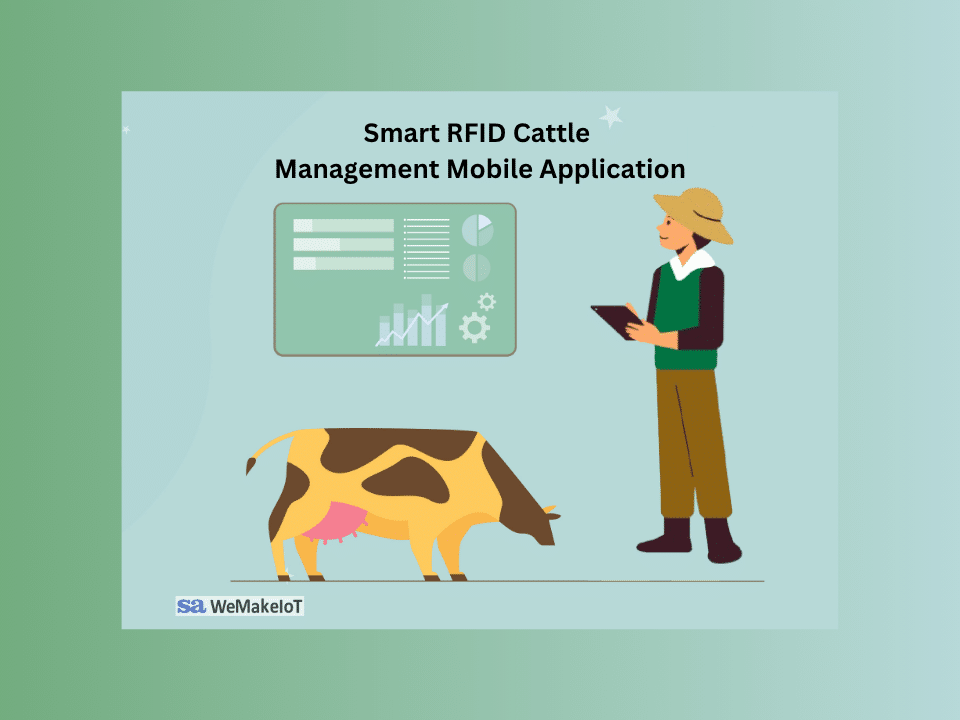
We built an RFID cattle management app for a rural livestock operation that needed to track animal location, health, and identification without a large enterprise system. Each animal carries an RFID tag. As tags are scanned in the field, a mobile app updates in real time — showing location, health alerts, and herd status as they happen, not hours later back at a desk. The app was built in Flutter specifically because farm teams use a wide range of Android devices, from budget phones to mid-range tablets, and the rendering needed to stay smooth and consistent across all of them.
This worked well for the deployment’s actual need: accurate identification and health records at handling points — gates, chutes, and pens — where animals pass a reader as part of routine handling anyway.
Why BLE Is Often the Better Fit for Cattle Tracking
RFID has a real limitation that matters for most livestock operations: it only knows an animal’s location the moment it’s scanned. Between scans, an RFID-tagged animal is invisible to the system. For an operation with open pasture, unfenced range, or a herd that needs continuous monitoring — not just checkpoint scanning — that gap matters.
BLE tags solve this by broadcasting continuously, rather than waiting to be read. A BLE ear tag or collar reports location and status on an ongoing basis to gateways positioned around the property, giving you a live view of where every animal is, not just where it was last scanned. This is a meaningful upgrade for:
- Detecting a missing or stray animal immediately, rather than discovering it’s gone at the next scheduled scan or headcount
- Monitoring inactivity or unusual movement patterns that can indicate illness, injury, or calving — something a point-in-time RFID scan simply cannot catch between visits
- Covering open or larger pastures without needing an operator to physically walk the herd with a handheld reader
- Reducing labour — no need to muster or funnel animals through a scanning point just to get a location update
Battery life and range make BLE practical at farm scale. Modern BLE cattle tags run for years on a single battery and communicate over ranges well suited to pasture-sized deployments, without the fixed reader infrastructure RFID gate-scanning requires.
When RFID Still Makes Sense
RFID remains the right choice when the goal is identification and record-keeping at defined touchpoints — a chute, a weighing station, a vaccination point — rather than continuous location tracking. It’s cheaper per tag, requires no battery, and fits naturally into handling routines that already funnel animals through a single point. If your priority is accurate health and treatment records tied to a handling event, RFID does that job well and cheaply.
Choosing the Right Approach for Your Herd
Need | Better Fit |
Identification and health records at handling points | RFID |
Continuous location tracking across the pasture | BLE |
Detecting strays or missing animals in real time | BLE |
Low-cost tagging for large herds at fixed checkpoints | RFID |
Early illness/calving detection via movement patterns | BLE |
Open or unfenced range | BLE |
Built for Small and Mid-Size Farms
Whichever technology fits your operation, you don’t need an enterprise ranch-management system to benefit. Start with a single pasture or a small herd, prove that the visibility is working, and expand only as your operation grows. No dedicated IT department, no complex backend — just real-time herd status on a mobile app your team can use in the field.
Get Started
If you run a small or mid-size cattle or livestock operation and want to know whether RFID, BLE, or a combination of both fits your herd and terrain, get in touch for a free consultation.