
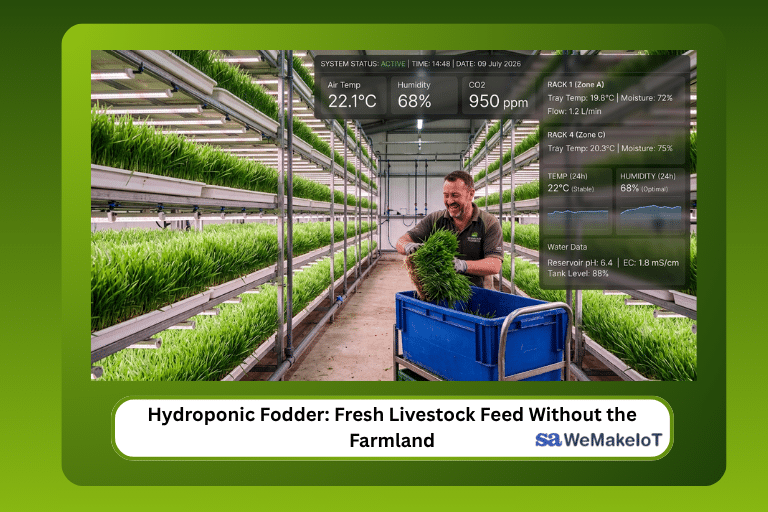
Hydroponic Fodder: Fresh Livestock Feed Without the Farmland
Farmers in the UK, US, and Australia are all facing the same squeeze: shrinking pasture, unpredictable weather, and rising hay prices. Hydroponic fodder is one answer worth knowing about.
What Is Hydroponic Fodder?
It's sprouted grain - usually barley, oats, wheat, or maize - grown without soil into a dense mat of roots, shoots, and leaves, ready to feed livestock in about a week. Think of it as microgreens for animals. Cattle, sheep, goats, poultry, and horses eat the whole mat: seed, root, and shoot, with almost no waste.
Green hydroponic barley fodder growing in stacked trays
How It's Done
- Soak the grain in water for 12-24 hours.
- Spread it thinly across shallow, perforated trays.
- Irrigate with a light mist or drip system a few times a day.
- Control the environment - around 21°C (70°F), 60% humidity, and good airflow, usually in a small greenhouse or shed.
- Harvest in 6–8 days once it forms a green, root-bound mat.
Why Farmers Are Trying It
- Grows year-round, regardless of drought, frost, or land availability
- Uses a fraction of the water - often cited at 3-4 litres per kg of fodder, versus far more for field-grown grass
- Ready in about a week, compared to weeks or months for a pasture crop
- Highly digestible, since sprouting converts starch to simpler sugars
Hydroponic Fodder vs. Natural Grass and Hay
| Hydroponic Fodder | Pasture / Hay | |
|---|---|---|
| Land needed | Minimal (indoor trays) | Large acreage |
| Water use | Very low | High, weather-dependent |
| Growing time | 6 - 8 days | Weeks to months |
| Dry matter content | Low (12 - 15%) | High (~85 - 90%) |
| Cost per lb (dry matter) | Higher | Generally lower |
| Weather dependency | None (controlled environment) | High |
The honest trade-off: hydroponic fodder is fresher and faster, but because it's mostly water, its dry-matter cost is usually higher than hay once you account for equipment, energy, and labour. Most producers in the UK, US, and Australia use it as a supplement to pasture or hay rather than a full replacement - it's most valuable when land or water is scarce, or during drought months when hay prices spike.
How WeMakeIoT Fits In
WeMakeIoT builds the sensor and automation layer that makes hydroponic fodder production reliable at scale. Their Automated Hydroponics Farm System project shows how IoT sensors and controllers (ESP8266, Arduino, Raspberry Pi) monitor water temperature and pH, and automatically adjust nutrient dosing - so trays don't dry out, freeze, or go out of balance unattended.
Beyond fodder, their broader Smart Farming platform covers greenhouse automation, soil and climate sensing, and remote monitoring dashboards - useful if you're building out a full smart-farm setup rather than a single fodder shed.
The Takeaway
Hydroponic fodder won't replace your pasture, but it can be a smart, space-saving supplement - especially where land or water is limited. Pair it with the right automation, and it becomes a low-labour, year-round source of fresh feed.
Want to explore automating your own fodder or greenhouse system? Get in touch with WeMakeIoT to talk through what IoT could do for your farm. Or head back to the WeMakeIoT homepage to explore the full range of smart farming solutions.