
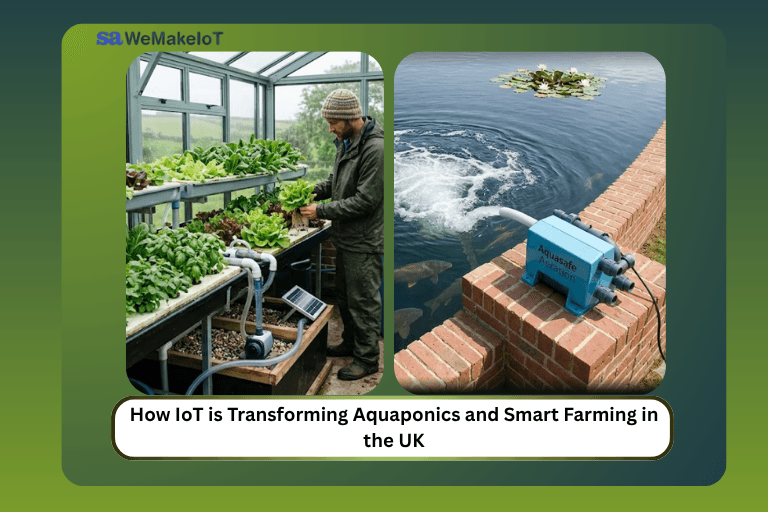
The UK Agritech Opportunity You Cannot Afford to Miss
The UK agritech market is growing fast. It reached $635 million in 2024 and is on track to exceed $1.7 billion by 2033. For startups and mid-sized companies building smart farming solutions, there has never been a better time to invest in IoT-powered agriculture.
But here is the challenge most decision-makers face: Which technology actually works in real farms? How do you monitor a live aquaponics facility without spending a fortune? And what does it take to build a system that runs reliably without someone checking it manually every few hours?
This guide answers those questions clearly. We will walk you through how IoT, LoRaWAN, ESP32, and Raspberry Pi are being used to automate aquaponics and precision farming in the UK and what WeMakeIoT has already built for clients in this space.
What is Aquaponics and Why Does It Need IoT?
Aquaponics is a closed-loop farming system that combines fish farming with crop cultivation, and it is gaining serious traction across the UK as a sustainable, water-efficient alternative to traditional agriculture. The challenge is that this ecosystem is fragile. Water pH, dissolved oxygen, and temperature all need to stay within precise ranges, 24 hours a day. One missed overnight reading can wipe out months of stock and thousands of pounds of investment.
IoT monitoring solves this by replacing manual rounds with continuous, automated sensor data and instant alerts, giving farm operators full visibility whether they are on-site or miles away.
We have covered the full picture of how this works in our dedicated piece: How SensorVision Powers Smart Aquaponics Systems. You can also see the real project we built in our LoRaWAN in the Aquaponics case study.
How LoRaWAN, ESP32, and Raspberry Pi Power Smart Farming in the UK
If you have heard the terms LoRaWAN, ESP32, and Raspberry Pi but are not sure what they actually mean for your farm or product, here is the explanation.
LoRaWAN: Long-Range Wireless for Farms and Fisheries
Think of LoRaWAN as Wi-Fi designed specifically for the countryside. Standard Wi-Fi covers maybe 50 metres indoors. LoRaWAN covers kilometres across open fields, through walls, and in outdoor environments where cellular signal is unreliable.
For UK farms and aquaponics facilities, this is transformative. A single LoRaWAN gateway can cover an entire growing facility or a large outdoor pond network. Sensors placed across multiple tanks or paddocks send data wirelessly to a central hub, without the need for cabling or a strong mobile signal.
LoRaWAN is also extremely low-power. Battery-powered sensors can run for years on a single charge critical for remote deployments where replacing batteries frequently is not practical.
At WeMakeIoT, LoRaWAN is one of our core specialisations. We have developed LoRaWAN networks across agricultural, industrial, and environmental monitoring projects in over 20 countries.
ESP32: The Brain Behind the Sensor
The ESP32 is a compact, affordable microcontroller, essentially the “brain” that sits inside each sensor device. It reads data from attached sensors (such as pH probes, temperature sensors, and dissolved oxygen sensors), processes it, and transmits it via LoRaWAN or Wi-Fi to a cloud platform or dashboard.
For aquaponics and agritech applications, the ESP32 is an ideal choice: it is energy-efficient, handles multiple sensor inputs simultaneously, and supports wireless communication out of the box. Our team at WeMakeIoT has used ESP32 extensively across smart farming, industrial monitoring, and building automation projects.
Raspberry Pi: The Gateway and Edge Processor
Where the ESP32 handles individual sensor nodes, the Raspberry Pi steps in when more processing power is needed. In a smart farming setup, a Raspberry Pi typically acts as the local gateway sitting between the sensor network and the cloud, processing incoming data, running local logic, and managing communication. For applications like computer vision (detecting crop disease from camera feeds), local data analytics, or coordinating multiple sensor nodes across a facility, the Raspberry Pi bridges the gap between field hardware and cloud infrastructure. WeMakeIoT uses Raspberry Pi as part of its agritech stack when projects require edge computing capability beyond what a microcontroller alone can handle.
LoRaWAN vs. Wi-Fi vs. 4G for UK Farm Deployments
When choosing a wireless technology for a UK farm deployment, the differences matter significantly. LoRaWAN covers up to 15 kilometres in rural open areas, runs on battery power for years, and keeps per-node costs low, making it the strongest fit for remote outdoor sensors across large fields or multi-tank aquaponics facilities. Wi-Fi, by contrast, is limited to roughly 50 metres, drains power quickly, and works best for short-range indoor applications rather than distributed farm networks. 4G and cellular options offer wide geographic coverage and suit mobile or isolated assets well, but the ongoing SIM costs add up quickly when deploying dozens or hundreds of sensor nodes at scale.
For most UK aquaponics and smart farming deployments, LoRaWAN is the clear winner for outdoor and large-facility sensor networks.
WeMakeIoT Case Study: Real-Time IoT Monitoring for a Smart Aquaponics System
WeMakeIoT has real-world experience building IoT solutions for aquaponics, not just theoretical knowledge.
One of our standout projects involved deploying a complete IoT monitoring and control system for an aquaponics facility. The client faced a common challenge: their team was spending significant time on manual water quality checks, and they had no visibility into their system outside of working hours. A single overnight equipment failure could result in major fish and crop losses.
Here is what WeMakeIoT built:
The System Architecture
- ESP32-based sensor nodes deployed across multiple tanks, each measuring water pH, dissolved oxygen, and water temperature continuously
- LoRaWAN wireless network using a master-slave gateway architecture, enabling seamless communication across the full facility without cabling infrastructure
- SensorVision IoT Platform as the central dashboard providing real-time data visualisation, historical trend analysis, and threshold-based alerts
- Automated pump control, pH dosing pumps, and oxygenation pumps were connected to the system, enabling automated adjustments when parameters drifted outside safe ranges
- Security monitoring alert notifications triggered by unauthorised access to pond areas, particularly valuable for overnight security
The Outcome
The farm manager moved from making multiple manual rounds per day to monitoring the entire facility remotely from a single dashboard with instant alerts via mobile if any parameter went outside the safe range. The system runs 24 hours a day, 7 days a week, without manual intervention.
You can read the full details of how SensorVision powers smart aquaponics systems on our website, and explore our full range of agriculture and aquaculture IoT projects in our success stories.
5 Critical Parameters Every Smart Aquaponics System Should Monitor
If you are planning an IoT aquaponics monitoring solution for the UK market, these are the five parameters your system must track and why each one matters.
1. Water pH Level
pH measures the acidity of the water. Most fish and plants in aquaponics systems thrive in a narrow pH range (typically 6.8 to 7.2). If pH drifts outside this window, fish become stressed, and nutrient uptake by plants is disrupted. IoT sensors monitor pH continuously and trigger automated dosing systems to correct it, eliminating the risk of dangerous overnight shifts going undetected.
2. Dissolved Oxygen (DO)
Oxygen dissolved in the water is what fish breathe. A sudden drop in dissolved oxygen caused by equipment failure, temperature changes, or algae blooms can kill an entire fish stock within hours. Continuous DO monitoring with instant alerts is one of the highest-value applications of IoT in aquaponics.
3. Water Temperature
Temperature affects fish metabolism, plant growth rates, and bacterial activity (the beneficial bacteria that break down fish waste into plant nutrients). Automated temperature monitoring allows operators to detect heater or chiller failures immediately before they cause lasting damage.
4. Water Level
Water level sensors across tanks and sumps ensure the system maintains correct volumes. Low water levels can expose pumps, cause equipment damage, and stress fish. Battery-powered LoRaWAN water level sensors like those in our Water Trough Monitoring project are ideal for remote and outdoor deployments.
5. Ambient Humidity and Air Temperature
For indoor aquaponics or greenhouse-based systems, ambient humidity and air temperature affect both the plant growing environment and equipment longevity. High humidity accelerates corrosion of electrical components, something IoT environmental monitoring can flag early, before it causes expensive failures.
Beyond Aquaponics: IoT for Broader UK Smart Farming Applications
Aquaponics is one of the most technically demanding agritech environments, but the same IoT infrastructure applies across a wide range of UK agricultural applications.
WeMakeIoT has also built:
- Haystack Monitoring wireless temperature sensors inside haystacks to detect dangerous heat build-up that can cause fire risk and crop loss
- Smart Irrigation Controller Systems automated irrigation control for agricultural providers, replacing manual field checks with sensor-driven scheduling
- Water Trough Monitoring battery-powered LoRaWAN sensors monitoring livestock water levels across remote paddocks
These projects share a common thread: they take a labour-intensive, error-prone manual process and replace it with automated, real-time IoT monitoring, freeing up farm staff for higher-value work and reducing the risk of costly failures going unnoticed.
What to Look for in an IoT Development Partner for Your Agritech Startup
If you are building an agritech product or deploying IoT infrastructure on a UK farm, choosing the right development partner is critical. Here are the questions to ask:
Do they have genuine hardware experience? Many software agencies claim IoT expertise but lack deep knowledge of firmware, sensors, and wireless protocols. Look for a partner who can handle everything from PCB design and firmware development to cloud dashboards and mobile apps under one roof.
Have they worked in agriculture or aquaculture specifically? Agricultural environments are harsh: outdoor humidity, variable power, wide temperature ranges, and the need for ultra-reliable, low-maintenance sensors. Experience in this vertical matters enormously.
Can they demonstrate working systems, not just proposals? Ask to see real case studies with real outcomes. Any credible IoT development company should be able to point to deployed systems, not just design documents.
Do they use open standards? Vendor lock-in is a significant risk in IoT. Ensure your development partner builds on open protocols (LoRaWAN, MQTT, REST APIs) so you are not dependent on a single hardware supplier or proprietary platform.
Can they scale with you? Moving from a 10-sensor prototype to a 500-sensor commercial deployment is a fundamentally different engineering challenge. Your partner needs production-grade experience, not just prototyping.
WeMakeIoT offers end-to-end IoT solutions development covering firmware, hardware, cloud platforms, and mobile applications with 120+ projects delivered across 20+ countries. We also offer IoT Research and Development services for startups at the early ideation stage who need technical guidance before committing to a full build.
The Platform Layer: SensorVision for Agritech Monitoring
One of the highest hidden costs of building a smart farming product is the software platform, the dashboard that collects sensor data, visualises it, and sends alerts. Building this from scratch takes months and significant engineering investment.
SensorVision is WeMakeIoT’s ready-to-deploy IoT platform, purpose-built for exactly this use case. It connects to any IoT device, stores incoming sensor data, renders real-time dashboards with customisable widgets, and delivers threshold-based alerts when parameters go out of range.
For agritech startups, SensorVision provides a faster, lower-cost path to market compared to building a custom platform from scratch while remaining fully customisable for your specific monitoring requirements.
Conclusion
The UK agriculture IoT market is expected to reach $2.69 billion by 2030. For startups and mid-sized agritech companies, that growth represents a significant opportunity but only for those who move quickly and build on reliable, scalable technology foundations.
IoT aquaponics monitoring using LoRaWAN, ESP32, and Raspberry Pi is not experimental technology. It is proven, deployable today, and delivers real returns for farms and aquaculture businesses that have adopted it. The combination of low-power wireless networks, affordable sensor hardware, edge computing, and cloud-based dashboards has made it practical and cost-effective at any scale.
WeMakeIoT has the experience, the technology stack, and the track record to help you build it right from the first sensor node to a fully deployed, production-grade system.
Ready to build your smart farming or aquaponics IoT solution?
Get a free consultation with the WeMakeIoT team
Explore more from WeMakeIoT:
- Our Agriculture & Aquaculture Projects
- LoRaWAN Technology Overview
- ESP32 IoT Development
- SensorVision IoT Platform
- Contact Us
Related WeMakeIoT Services