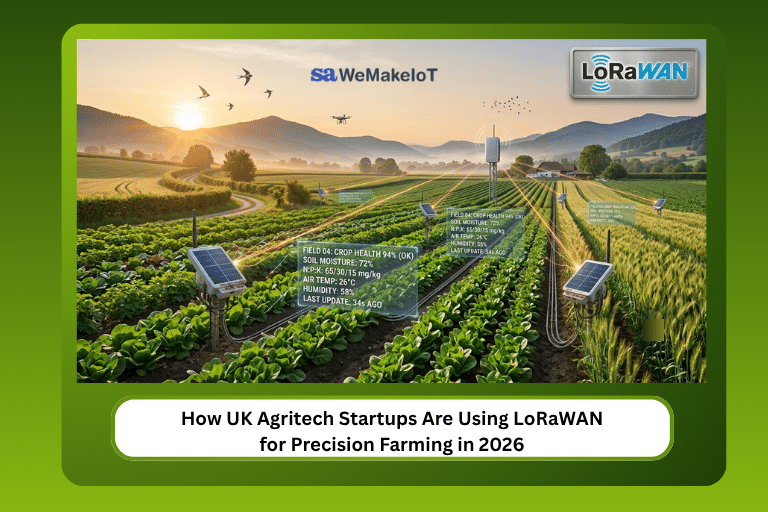
How UK Agritech Startups Are Using LoRaWAN for Precision Farming in 2026
The UK agritech sector isn’t slowing down. According to IMARC Group’s market research, the market was valued at $635 million in 2024 and is projected to reach $1.76 billion by 2033, with a significant part of that growth driven by startups moving away from guesswork farming toward sensor-driven, data-backed decisions. The technology making this possible for UK farms, more often than not, is LoRaWAN.Why LoRaWAN Fits UK Farms So Well
Most UK farmlands don’t have reliable Wi-Fi or cellular coverage stretching across every field, polytunnel, or livestock shed. LoRaWAN solves this with long-range, low-power connectivity – a single gateway can cover several kilometres, and sensor nodes can run for months or years on a small battery. For precision farming, where you need dozens of sensors spread across acres, that combination of range and battery life is hard to beat.What UK Agritech Startups Are Actually Building With It
A few precision farming applications we’re seeing gain traction across the UK right now:- Soil moisture and irrigation automation – sensors trigger irrigation only when soil conditions actually need it, cutting water waste
- Livestock and water trough monitoring – tracking water levels and flow remotely instead of manual field checks
- Hay and forage storage monitoring – temperature and moisture sensors inside stored haystacks, catching the early heat build-up that leads to spoilage or spontaneous combustion, long before it’s visible from outside the stack
- Greenhouse and polytunnel climate control – temperature and humidity data feeding automated ventilation
- Aquaponics and controlled-environment farming – closed-loop systems where water quality has to be monitored continuously
Getting Started Without Overbuilding
Most startups don’t need a custom platform on day one. A typical LoRaWAN precision farming setup is just three pieces:- Sensor nodes (soil, water, temperature, or livestock trackers)
- A gateway to collect and forward the data
- A dashboard to visualise it and set alerts